
Steel platform
SteelCore
SteelCore is positioned for C2, C3 and C4 exposure with the project-appropriate material and corrosion-protection system.
You are here

Lumax steel fixed-tilt platform
SteelCore is Lumax Energy's steel fixed-tilt Ground Mount platform for commercial, industrial and utility-scale solar projects.
The platform is developed for structural efficiency, scalable manufacture and project optimisation. SteelCore is available as a standard pre-engineered kit for suitable projects or as a custom-engineered structure designed around the site loading, module arrangement, terrain, foundations, corrosion exposure and construction method.
Platform evaluation
SteelCore gives Lumax an all-steel primary structural platform that can be configured for robust construction and efficient repetition across commercial and utility-scale sites.
Steel grades, member forms, support spacing, connections and protection systems can be selected around the engineering and commercial requirement.
The value of SteelCore comes from the complete design. Project scale, structural loads, fabrication, material utilisation, transport, foundations and installation determine whether SteelCore provides the better installed outcome.
The project benefits from a robust all-steel primary structure and scalable manufacture.
The environmental exposure falls within the SteelCore C2 to C4 positioning and an appropriate corrosion-protection system can be specified.
Support spans up to 4 m are appropriate, subject to loading and project engineering.
Direct-driven piles provide an efficient foundation route for a suitable larger site.
A standard SteelCore kit falls within the wind, loading, geometry and site parameters.
A larger project can benefit from custom optimisation of table geometry, support spacing, materials, foundations and installation.
SteelCore uses steel primary members, while AluCore uses aluminium primary members. The material route changes member design, corrosion strategy, fabrication, handling and commercial optimisation.
Steel platform
SteelCore is positioned for C2, C3 and C4 exposure with the project-appropriate material and corrosion-protection system.
Aluminium platform
AluCore may be considered for applications up to C5, subject to project review.
Where both platforms can satisfy the exposure and loading, Lumax compares the complete installed structure and project requirements before making a recommendation.
GM-01 · Confirmed SteelCore arrangements
End elevations of the module arrangements supported by SteelCore. SteelCore supports spans up to 4 m, subject to the project loading, module geometry and structural engineering.
Schematic · Not to scaleSee what information helps Lumax assess each arrangement. A preliminary layout or preferred tilt is useful if available; you do not need a final design to start.
Two modules in portrait
Tilt range10° to 25°
2P Portrait
Share the module datasheet, preliminary layout and preferred tilt, if known. Lumax reviews module dimensions, loading and site conditions to establish the final table geometry and tilt.
Three modules in portrait
Tilt options10° or 15°
3P Portrait
If known, indicate whether the preliminary layout uses 10° or 15° and share the module datasheet. These are two design options; Lumax confirms the final arrangement against module dimensions, loading and site conditions.
Two east, two west
Tilt range10° to 15°
East-West / 4P
Show the intended east- and west-facing module arrangement in the preliminary layout, if available, and share the module datasheet. Lumax reviews module dimensions, loading and site conditions before confirming the final geometry.
Project conditions
Wind
Standard SteelCore designs are available for SANS wind regions of 36 m/s and 44 m/s. Lumax reviews the project location, loading, terrain and array geometry to determine whether a standard design applies. Where the project falls outside the standard design envelope, a custom-engineered SteelCore solution can be developed.
Terrain
North-South terrain is assessed for each project. East-West slopes of up to 3° can be accommodated, subject to the final project design, table arrangement and actual site conditions.
Corrosion
SteelCore is positioned for C2, C3 and C4 environments. The required steel grade, metallic coating, paint or combined protection system is selected for the actual exposure and project requirements.
GM-02 · Corrosion exposure
Corrosion Positioning by Platform
Corrosivity categories used as selection context for AluCore and SteelCore.
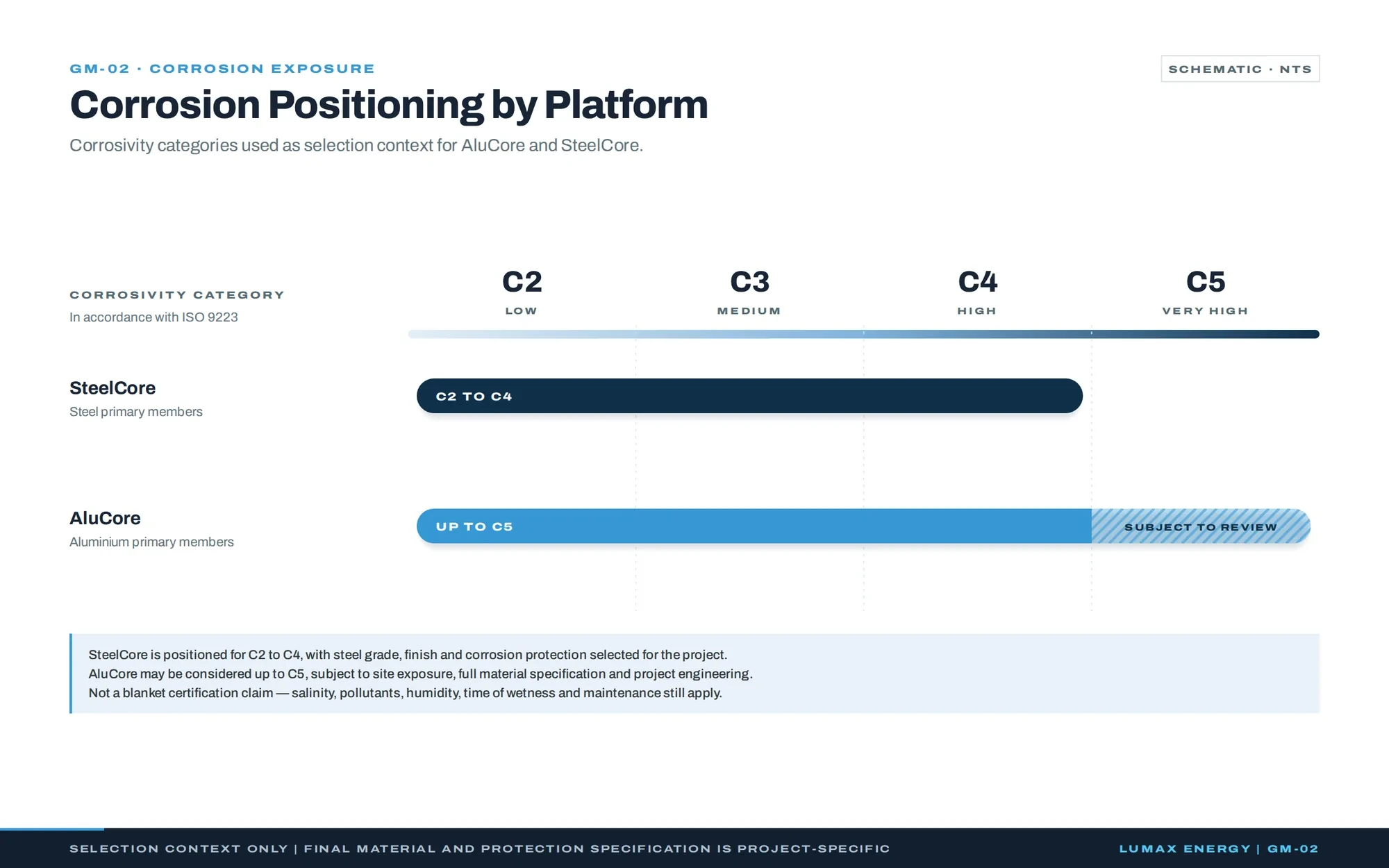
The C2 to C4 terminology describes atmospheric corrosivity context. ISO 9223 establishes a classification system for atmospheric corrosivity. ISO 12944 uses environmental classification as one important input when protective paint systems for steel structures are selected.
The category alone is not a guarantee of service life and does not replace a project-specific material and protection specification.
GM-03 · Foundation strategy
Direct-driven piles are normally the preferred SteelCore foundation method on larger sites where ground conditions support reliable installation. This method is generally fast and cost-effective at scale, but requires specialist plant and verified site performance.
Lumax assesses the following foundation routes for each site:
Illustrative foundation routes, not supplied member, connection, anchor or reinforcement details. Final type, section, depth and installation are project-engineered. Not for construction.
Normally preferred where ground conditions support reliable installation and verified site performance.
01 · Direct-driven piles
Normally preferred for larger projects where ground conditions allow reliable installation. Direct driving is generally the fastest and most cost-effective method at scale, but it requires specialist piling equipment and verified site performance.
Where harder layers or local refusal make direct driving difficult.
02 · Pre-drilled and driven piles
Used where direct driving is difficult but a driven-pile solution remains practical. Pre-drilling assists installation through harder layers or local refusal conditions while retaining the pile-based foundation approach.
Where effective pile driving is not practical and drilled, concreted supports are required.
03 · Drill-and-concrete
Used where effective pile driving is not practical, particularly on larger sites where ground conditions require drilled holes and a concreted pile or post arrangement.
Where the soil, access or project requirements justify this approved higher-cost alternative.
04 · Ground screws
Foundation selection follows the site conditions and project design. Direct-driven piles are normally preferred for larger installations where ground permits. Ground screws provide an alternative where appropriate, usually at a higher cost.
For smaller sites or suitable standard-kit applications where specialist piling equipment is not commercially justified.
05 · Conventional concrete foundations
Normally considered for smaller sites and suitable standard-kit projects where mobilising specialist piling equipment would not be commercially justified. The civil foundation and structural anchoring scope must be clearly defined for the project.
Required site validation
For every project using direct-driven piles, on-site pull-out testing is mandatory and must be completed before manufacture. Testing confirms pile embedment and verifies the foundation assumptions used in the structural design.
Sequence for direct-driven piles
Direct-driven pile foundation selected
On-site pull-out testing completed
Pile embedment confirmed and foundation design assumptions verified
Manufacture proceeds
Commercial and technical route
GM-06 · Commercial and technical route
Project inputs
Within the approved standard design envelope?
Yes
Standard SteelCore kits are available for common configurations, subject to availability and the project falling within the approved design parameters. This is often the most practical route for projects of approximately 1 MW and smaller.
No · or scale justifies optimisation
For projects above approximately 1 MW, a custom-engineered SteelCore structure is generally more cost-effective because support spacing, table length, member sizes, foundations, connections and material utilisation can be optimised and repeated across the full project.
Scale creates the opportunity to optimise
Larger projects may still use standard kits. Lumax compares both routes before recommending the better project outcome. The lowest-cost member is not necessarily the lowest-cost installed solution.
Lumax can begin the SteelCore assessment and prepare a preliminary quotation before complete geotechnical information is available. The initial basis can use the project location, capacity, module datasheet, proposed layout, tilt and declared assumptions to assess configuration, standard-kit suitability and likely foundation routes.
The structure and foundation basis are refined when site and geotechnical information becomes available.
The applicable structural loading, steel design, corrosion-protection and project requirements are confirmed for the agreed scope and project location. Deliverables can include project drawings, structural calculations, foundation information, bills of material, installation information and professional engineering sign-off where included in the appointment.
SteelCore questions
SteelCore is normally considered where a robust all-steel structure, scalable manufacture, structural efficiency and project optimisation align with the site, exposure and commercial requirements.
SteelCore is positioned for C2, C3 and C4 environments. The steel grade and metallic, paint or combined protection system are selected for the actual exposure and project specification.
No. Direct-driven piles are normally preferred on suitable larger sites, but pre-drilled and driven piles, drill-and-concrete, ground screws and conventional concrete can also be assessed.
Yes. Lumax can begin with available project information and declared assumptions, then refine the structure and foundation basis when site and geotechnical information becomes available.
No. On-site pull-out testing is mandatory whenever direct-driven piles are selected and must be completed before manufacture.
The current configurations are 2P portrait at 10° to 25°, 3P portrait at 10° or 15°, and East-West / 4P at 10° to 15°. SteelCore supports spans up to 4 m, subject to loading, module geometry and project engineering.
A standard kit is often the most practical route for projects of approximately 1 MW and smaller when the wind, loading, geometry, exposure and site requirements fall within the approved design parameters.
Above approximately 1 MW, custom engineering is generally more cost-effective because support spacing, table length, member sizes, foundations, connections and material utilisation can be optimised and repeated across the project.
Send Lumax the project location, approximate MW size, module datasheet, preliminary layout, preferred configuration and tilt, available geotechnical or topographical information, corrosion requirements and relevant tender documents. Lumax will assess whether a standard SteelCore kit or custom-engineered structure offers the better project outcome.